



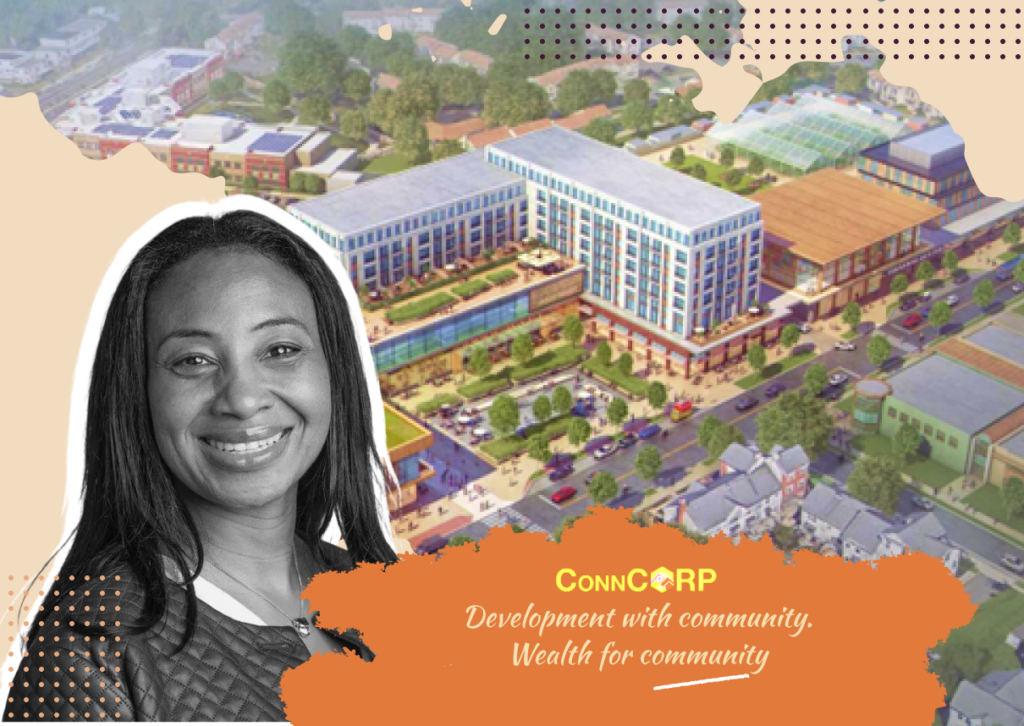
“It’s always the same thing – we always get the leftovers. We always get promises. But they never materialize.”
— Kiara Clemons at a Dixwell Plaza community meeting, circa 2014
That’s not a critique of a single project. It’s a description of how redevelopment has shown up in urban communities across the country for decades. Capital flows in. Projects get built. But the investment returns flow back out and residents often remain disconnected and even excluded from the long-term value those projects create. In New Haven’s Dixwell neighborhood, once known as the city’s “Black Main Street,” that pattern has persisted for generations.
First HAVEN in Dixwell is trying to help reverse it.
The $200 million mixed-use development is more than a redevelopment of a blighted strip mall. It’s a comprehensive regenerative community development to rebuild the local economic ecosystem—combining housing, retail, workforce development, business incubation, childcare, and arts and cultural space into one coordinated strategy.
Behind that effort is ConnCORP, the economic development and investment arm affiliated with the Connecticut Center for Arts and Technology (ConnCAT). ConnCORP focuses on acquiring and revitalizing real estate, investing in local businesses, and building a place-based economic engine in underserved communities. That economic engine, as a social enterprise, helps fuel the philanthropic programming of ConnCAT, including workforce training and youth development programs. One of the leaders of ConnCORP’s investment and real estate effort is Anna Blanding, Chief Investment Officer of ConnCORP.
Before joining ConnCORP, Blanding invested across private equity, venture capital, real estate, and private credit at institutions like the Annie E. Casey Foundation and Choate Rosemary Hall. She brings an institutional investor’s lens to a hyper-local problem: how to structure capital so that it actually enhances outcomes for the people who live in a community.
Emerge spoke with Blanding about how real estate became an essential vehicle—and what it looks like when development is designed in collaboration with a community to better serve the people already living in that community.
Emerge
You’ve spent your career deploying capital across institutional portfolios. Why real estate—and why here?
Anna Blanding
I wish I could say I planned my career perfectly. I didn’t. But what made it appealing is the intentional way that we’re using real estate as a social enterprise and revenue engine to create immediate and long-term change in the neighborhood.
In our approach, coming to life now in First HAVEN on Dixwell, we know that communities must not simply experience development, they must help shape it, lead it, and benefit from and own its outcomes. We began our efforts here with workforce training programs in health fields and culinary arts, but quickly saw there was much more needed. In First HAVEN, we have a variety of needed social services baked in. There’s daycare for the community, adult workforce training, a mental health trauma clinic, a grocery store and performing arts. These are all things residents said they needed, hoped for.
But many of these programs and social services are provided for free or rely on philanthropy, which poses sustainability challenges for the community. We started thinking about the issues like a place-based impact investment. How do you meet those needs in a financially sustainable way? And that’s where real estate becomes really powerful. You can have housing, office, retail—things that generate income and help support the pieces that don’t, so it becomes something sustainable, not solely charitable activities that need to be funded over and over again.
Phase 1A of First HAVEN has already shown that this kind of work requires a blended approach—philanthropic capital alongside public and private capital partners who understand the broader market opportunity. As the project moves into its next phase, the goal is to continue that same blended capital stack, in order to ensure the development generates wealth for the community, as opposed to extractive obligations.
Emerge
You’ve talked about the built environment shaping how people see themselves.
Anna
Yes, and I’ve really learned that through this work. Art and beautiful spaces are powerful emotional conduits as well as economic development engines. If you’re in a place that feels run down, or like you’re getting what’s left over, that affects you. It affects how you see yourself, what you aspire to, and probably even more, how your kids see themselves. That emotional reaction came up a lot from early on in our community conversations. People saying “we always get the leftovers. We always get promises that never materialize.”
For us, it was important that this felt different. That it felt like, “This is first-rate. This has care. This is best-in-class.” That’s why we were intentional about design, about the team. My ConnCORP colleagues are best in class, CEO Erik Clemons, COO Paul McCraven, President Phil Rigueur, CFO Lovel Cassells, the entire ConnCORP and ConnCAT staff. I work with the most brilliant, creative, caring, funny, and tenacious leaders in the world. We decided to engage renowned architect Peter Cook, that co-designed the National Museum of African American History and Culture in Washington DC. It’s not just about the building. It’s about what the hope it represents. From the very start, we’ve known that art, music, beauty and cultural pride were critical to the community seeing its value and believing in themselves and each other.
Emerge
The history of Dixwell is intriguing and something most people don’t know. Can you share a bit of that story?
Anna
I didn’t fully know it either when I first came to New Haven nearly three decades ago, but there’s a deep and rich history here. Two local churches, Varick A.M.E. and Dixwell Avenue Congregational United Church were refuges on the Underground Railroad. The Black Panthers were here in the 60s, the Bobby Seale trial. Constance Baker Motley, a pioneering lawyer and first Black woman federal judge, grew up in Dixwell. So New Haven has a deep history in the American social fabric that most people don’t appreciate.
Dixwell specifically was a thriving Black economic corridor, called “Black Main Street.” You had Black-owned businesses, doctors, grocery stores, culture, music places like Monterey Jazz Club. It was similar to other communities across the country that had a real circular economy like my home town of Tulsa, Oklahoma and Greenwood and Black Wall Street. And then, over time, the major industries left, urban renewal happened, the strip mall came in, and things declined. But people still remember what it was like back then. For us, it’s about asking “how do we bring that energy and vitality back, in a way that works today?”
Emerge
There’s also something striking about the proximity to Yale, and the disconnect.
Anna
That’s something I saw early on. You see stark economic differences block to block in New Haven. The wealth inequity is jarring. When I first came to Yale for undergrad, one of our first freshman workshops was hosted by campus police. And they basically said, “don’t go past this street,” because it wasn’t deemed safe. Thankfully, I ended up going to church in the Dixwell and Newhall community. Even though I was at Yale, I also had an extended village of people who cared for me, invited me into their homes after church, drove me on errands, and fed me, literally and spiritually! I experienced a New Haven beyond campus. That was a very different experience than a lot of students who stayed on campus and then went straight to JFK or Bradley to go home. And what stood out to me is how spatially close everything is in New Haven but how separate it feels.
Fast forward, I remember mentoring a valedictorian from the largest public high school in New Haven. When I asked her, why with her grades, she hadn’t applied to Yale, she said it just didn’t feel like an option.
That’s a clear example of how many people from the local community feel about Yale, that it’s not for us, and it’s unfortunate.
Part of this work is changing that perception so people believe these opportunities in New Haven, Yale, the biosciences and tech opportunities, are actually for them and that we have agency.
Emerge
How much of the project came directly from the community?
Anna
Really all of it. This is truly a community centered design approach. We’ve intentionally engaged directly with the community through years of meetings, a lot of conversations, a lot of feedback. And people were clear, they wanted quality jobs, businesses, quality daycare, food, housing, green space and places to gather in community. Everything we’re building reflects that. It’s not just our vision, it’s what the community said they needed and yearned for. And we’ve been at it for fifteen years, starting with tuition-free workforce training for adults and transformative arts education for youth through our nonprofit, Connecticut Center for Arts and Technology. We’ve built the knowledge and trust in communion with the community and they know ConnCORP and First HAVEN as something that’s for them.
Emerge
You also supported local businesses during COVID. What did that experience change for you?
Anna
That was a moment of deep awakening. In March 2020, we started by providing debit cards to nearly 1,000 families, but quickly realized local businesses were struggling just as much, especially Black-owned businesses. A lot of them didn’t have much cushion. Maybe a couple weeks of cash. And many were dependent on foot traffic, so when everything shut down, it hit hard. So, we started giving grants—about $10,000 each—and pairing that with technical assistance. We also purchased a 50,000 sq foot business incubator in 2021, the Lab at ConnCORP and later developed an entrepreneurship academy in collaboration with Quinnipiac University focused on Black and women-owned business development as well as a variety of entrepreneurial supports. That’s now in its 4th cohort. We are currently renovating two floors of our lab to create even more premium office space for businesses to locate to Hamden. That 16,000 of additional office space will come online in June.
What’s been great is, all those businesses we supported with our Economic Justice Fund grants are still around. They’ve grown in revenue and profit, they’ve hired more staff, they’ve created new product lines. In the black community, the reality is our businesses are impact companies—even if we don’t describe themselves that way. We hire people who live in the community. We give backpacks to school children. We provide scholarships. That’s just what we do. When businesses are strong, the community is stronger.
I didn’t fully appreciate how critical Main Street businesses are to the functioning of a healthy community until the pandemic.
Emerge
When this is done—what does success look like?
Anna
I’ll answer that in the short-term and the long-term.
In the short-term, it’s celebrating our grand opening of Phase 1 of First Haven in Dixwell on Juneteenth! Then having a successful capital raise to complete the next phase of construction. It’s helping local residents and businesses thrive in a meaningful way. We’ve made it a priority to hire local and MBE subcontractors on the project—which is huge—but also working with our general contractor to make sure subs don’t have to float cash flow for long periods before getting paid. That matters more than people realize. We added a construction academy to our workforce programs to build a job pipeline inside our own building project and construction projects around the city and have seen already great success with members of the community transforming their lives.
And then longer-term, we anticipate First HAVEN will add over 600 jobs and deliver nearly a billion dollars over the next ten years in this community. We’ll know we’re successful when we really deliver on that potential. When the community residents walk by, as they’re already beginning to do, and feel proud of what this symbolizes and feel like it’s theirs. And when children growing up here see and feel something different—see what’s possible for their lives in a way that feels real.